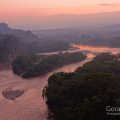
Bomburu Ella (Perawella Falls) is one of Sri Lanka’s most beautiful, natural-feeling waterfalls: a wide, multi-tiered cascade near Nuwara Eliya and Welimada, reached by a ~30–45 minute hike through forest-edge village paths.
Bomburu Ella doesn’t arrive as a single dramatic “drop.” It arrives as a wide, multi-ribboned cascade, a spill of white water that breaks into several curtains and threads, sliding over dark rock and green ledges. You feel it before you see it: the dampness in the air, the low thunder, the sense that the hillside is breathing water.
It’s often described as one of the most beautiful and natural waterfalls in Sri Lanka—not because it’s remote in a wilderness sense, but because it still feels alive, textured, and untamed at the moment you stand in front of it.

Where is Bomburu Ella Waterfall?
Bomburu Ella—also known as Perawella Falls—lies in Sri Lanka’s Central Highlands, near the border of Nuwara Eliya and Badulla districts, in the Uva-Paranagama area. A useful reference point is Welimada, roughly 15 km away, while Nuwara Eliya is a common base for visiting.
You’ll sometimes see it described as Sri Lanka’s widest waterfall, because it’s not one fall but a clustered system—multiple cascades grouped together across a broad rock face.


How to get there
Most travelers visit as a day trip from Nuwara Eliya, or approach from the Welimada / Badulla side. The drive brings you to a parking/trailhead area, and from there the experience becomes the kind you actually remember:
- You must hike to reach the main falls.
- The walk is typically around 30–45 minutes from the road/parking area, depending on pace and trail conditions.
The hike and the feel of the visit
This is a natural waterfall, but it’s not a sealed-off, “pure wilderness” attraction—and that contrast is part of its charm.
The first part of the approach can lead you through the edge of local life: small buildings, occasional stalls on busier days, and a path that feels like it belongs to the community as much as it belongs to travelers. And yes—Bomburu Ella is also linked to water infrastructure: parts of the route run alongside channels/structures that connect the water to practical use (you’ll notice it in the engineered edges and concrete elements you pass).
Then the landscape starts to pull you inward: greener, wetter, softer. The path opens into a rocky amphitheater where the waterfall suddenly spreads across the cliff—a layered wall of water with multiple streams, mist drifting over boulders, and vegetation clinging to every surface that can hold life.

What to do once you arrive
- Slow down. Bomburu Ella rewards stillness: watch how the flow splits and recombines, how the spray turns sunlight into a pale veil.
- Choose your vantage point. You can stay lower for the full-width view, or carefully move around the boulders for different angles.
- Be cautious with water and rocks. The terrain is slick and uneven, and strong flow can make “easy-looking” spots surprisingly risky.

Type of waterfall
Bomburu Ella is best described as a multi-tiered cascade system (a segmented waterfall complex): several smaller waterfalls grouped together to form one broad, dramatic feature. That “grouped” structure is exactly why it’s known for its width—more like a waterfall family than a single plunge.
📚 Want to understand waterfall names?
“Falls”, “cascades”, “tiers”, “horsetail”, “plunge” — the words actually mean different things.
Read the guide: Different Names of Waterfalls →
Geology: why it looks the way it does
Bomburu Ella sits within the Central Highlands, where the bedrock is dominated by ancient crystalline metamorphic rocks (including rock types such as gneisses and charnockites in the Highland Complex). In landscapes like this, water exploits fractures and weaknesses in hard bedrock. Instead of carving one neat chute, the flow often spreads and braids—creating multiple parallel curtains and ledges that shape a wide, tiered cascade.
In other words: the geology here doesn’t just hold the waterfall up—it composes it.


Is it worth it?
Yes—especially if you want a waterfall that feels earned. The hike is long enough to make the arrival satisfying, but not so hard that it becomes an expedition. And while it isn’t completely wild (the human presence and water systems are real), the waterfall itself still feels gloriously natural: wide, loud, misty, green—Sri Lanka at full volume.
Sources
- Bomburu Ella / Perawella Falls location near the Nuwara Eliya–Badulla border; ~15 km from Welimada; description as widest and grouped cascades: Wikipedia+1
- Visitor logistics, hike time/distance framing and general visit tips: Laure Wanders+1
- Entrance fee figures reported by recent travel guides (fees can change): Laure Wanders+1
- Geology context: Sri Lanka dominated by Precambrian crystalline metamorphic rocks; charnockite common in Sri Lanka’s Highland Complex: National Rock Garden+1