Devon Falls, Sri Lanka: A Waterfall Among the Tea Fields
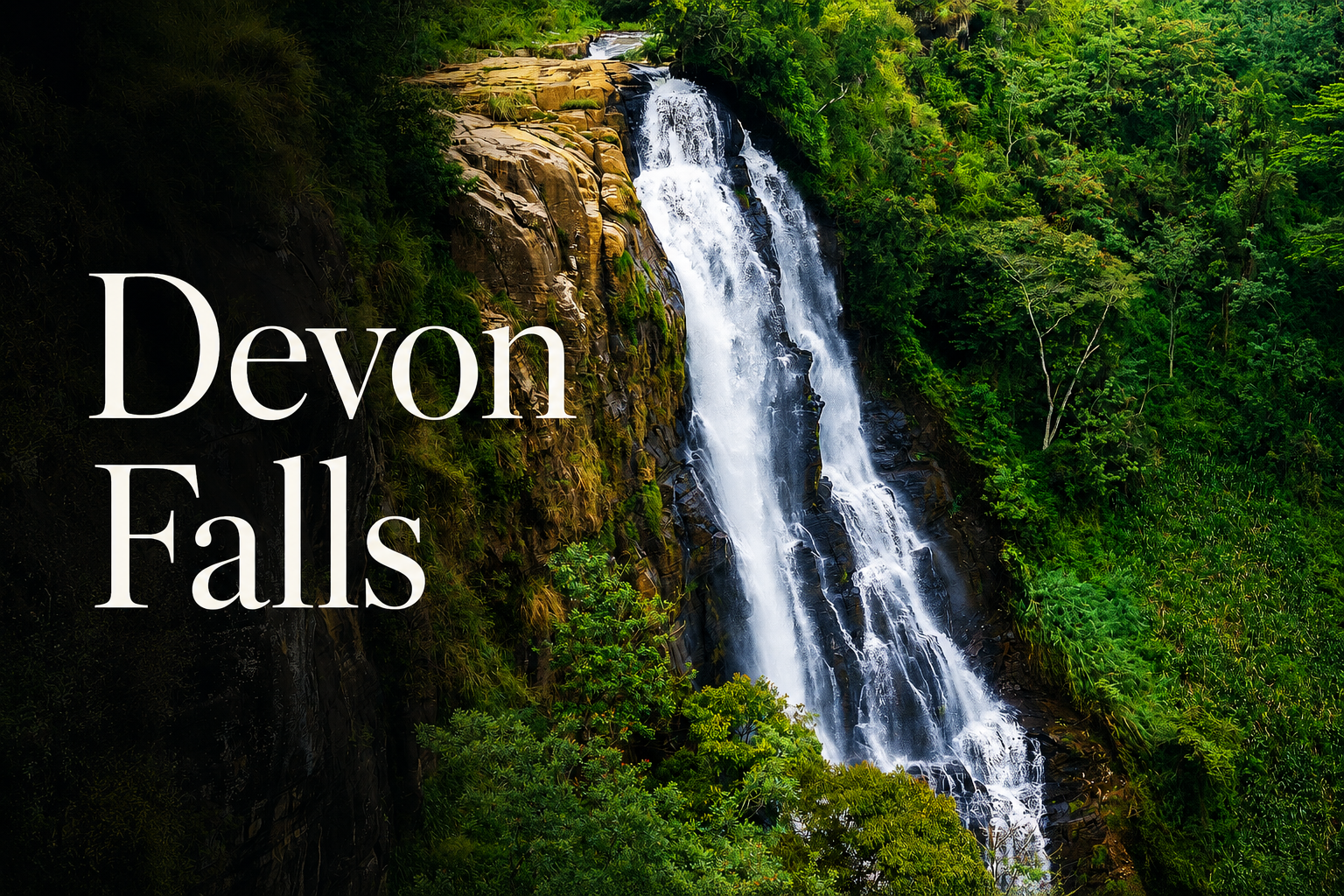
Discover Devon Falls in Sri Lanka’s central highlands, including the best viewpoint, how to visit, and what makes this 97-metre waterfall worth stopping for.
There are places in Sri Lanka that announce themselves with temples, crowds, and roadside signs. Devon Falls appears more quietly.
The road bends through the central highlands, past tea plantations and mist-covered hills, and suddenly the waterfall comes into view across the valley — a long white cascade falling through layers of dark rock and dense green vegetation.
It is the kind of place that makes you ask the driver to stop, even when it was never part of the plan.
A Waterfall in Sri Lanka’s Tea Country
Devon Falls is located near Talawakele in the Nuwara Eliya District, along the road connecting Hatton and Nuwara Eliya. It lies in the heart of the Dimbula tea-growing region, surrounded by some of the landscapes most closely associated with Sri Lanka’s central highlands.
The waterfall drops approximately 97 metres in three stages, earning it the poetic nickname “Veil of the Valley.” It is formed by a tributary of the Kothmale Oya, which eventually feeds into the Mahaweli River.
From a distance, the water looks almost delicate. It spreads across the cliff face before narrowing again, disappearing briefly behind the trees and continuing into the valley below.
Yet the closer you look, the more powerful it feels.
Discover more of Sri Lanka’s most beautiful waterfalls, from famous cascades to lesser-known places hidden in the highlands. Explore the full guide →
Why Is It Called Devon Falls?
The waterfall was named after an English coffee planter called Devon, whose plantation once stood nearby.
Before tea became the defining crop of Sri Lanka’s highlands, many estates in this region were used for coffee cultivation. The surrounding Devon Tea Estate was originally one of those coffee plantations.

The name is a small reminder of how deeply the landscape of the central highlands has been shaped by the island’s colonial plantation history.
Today, rows of tea bushes cover the surrounding slopes, their carefully trimmed patterns contrasting with the wild forest around the waterfall.
The Best Viewpoint for Devon Falls
The easiest way to see Devon Falls is from the roadside viewpoints along the A7 highway.
One of the best-known viewing areas is near the Mlesna Tea Centre, where the waterfall can be seen across the valley. The viewpoint offers a wide, unobstructed perspective of the main cascade and the tea-covered landscape around it.
You do not need to hike to appreciate Devon Falls. That is part of what makes it such an easy addition to a journey through Sri Lanka’s hill country.
Stop for a few minutes, watch the mist moving through the valley, and allow the road trip to slow down.

When to Visit Devon Falls
Devon Falls can be visited throughout the year, although its appearance changes with the weather.
After periods of rain, the waterfall becomes wider, louder, and more dramatic. During drier months, the flow may be gentler, revealing more of the dark rock behind the water.
The highlands are often cloudy, particularly during the wetter seasons. A waterfall partly hidden in mist can be beautiful in its own way, but low cloud may occasionally obscure the view altogether.
Early morning or late afternoon usually offers softer light and a quieter atmosphere. Weather in the hills can change quickly, however, so it is worth stopping whenever the waterfall is clearly visible.
Visiting Devon Falls on the Road to Nuwara Eliya
Devon Falls works particularly well as a short stop while travelling between Hatton, Talawakele and Nuwara Eliya.
It is also located close to St. Clair’s Falls, another of Sri Lanka’s best-known waterfalls. Both can easily be visited during the same journey, together with tea estates and viewpoints scattered throughout the surrounding hills.
There is no need to build an entire day around Devon Falls. It is not that kind of destination.
Its beauty lies partly in the interruption — a sudden view across the valley, a few quiet minutes beside the road, and the feeling of discovering something magnificent without having to search for it.
Is Devon Falls Worth Visiting?
Devon Falls is worth visiting when you are already exploring Sri Lanka’s central highlands.
It may not offer the adventure of hiking to the top of Diyaluma Falls or the immersive jungle setting of some smaller waterfalls. Instead, Devon Falls offers something simpler: a graceful cascade framed by tea fields, forest and shifting mountain weather.
It is easy to reach, free to view and perfectly placed along one of Sri Lanka’s most scenic roads.

Final Thoughts
Some places stay with you because of what you did there. Others remain because of how unexpectedly they appeared.
Devon Falls was one of those places for me.
A waterfall across a distant valley. Tea fields disappearing beneath the clouds. Rain moving softly through the hills.
We stopped only briefly before continuing toward Nuwara Eliya, but the view lingered far longer than the visit itself — a quiet reminder that some of Sri Lanka’s most memorable moments happen somewhere between one destination and the next.


