Why Sediment Loss Is Quietly Destroying Rivers
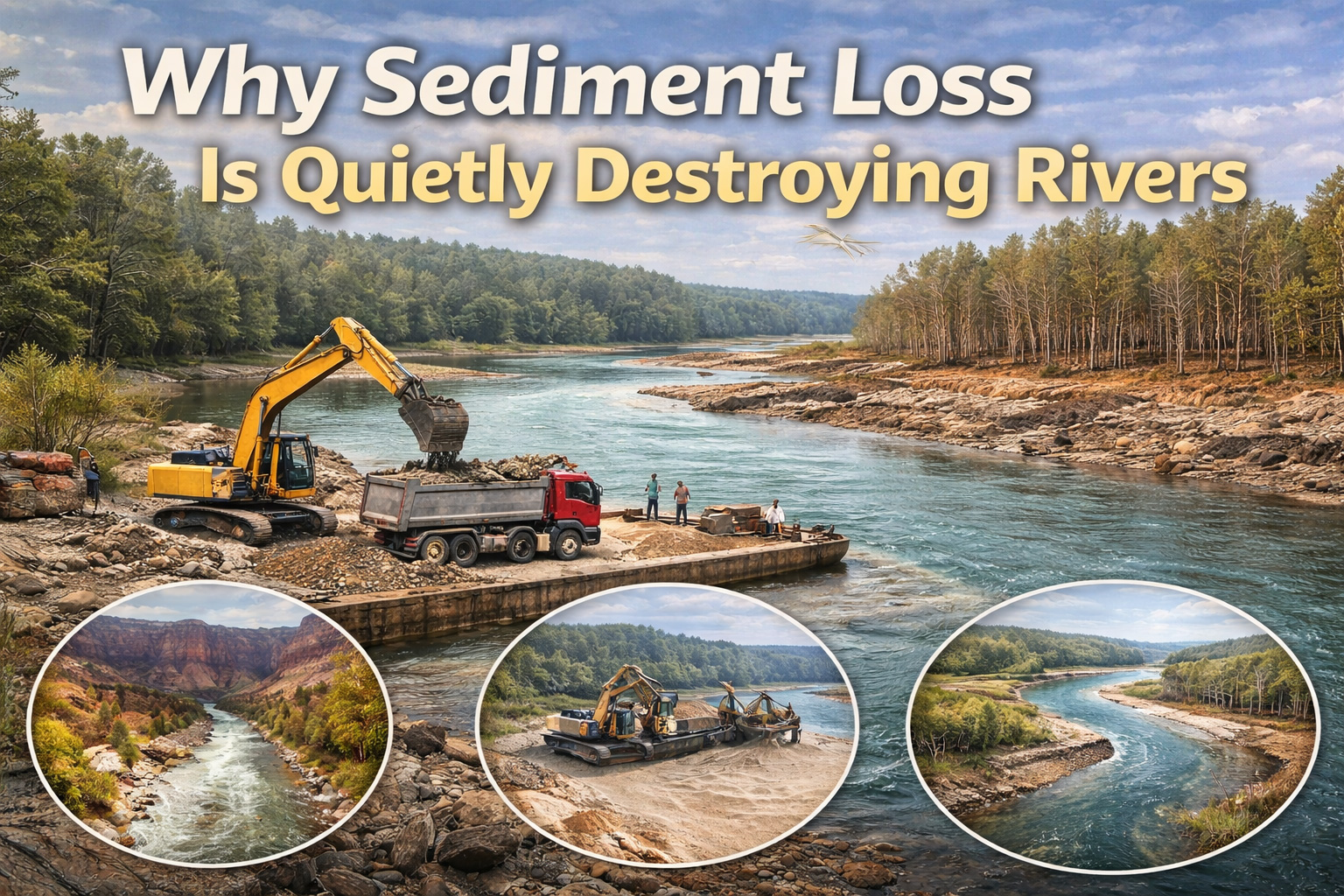
Sediment loss is deepening riverbeds, lowering groundwater, drying floodplain forests, and weakening rivers worldwide. Here is why it matters.
Sediment is often treated as if it were just loose material in the way — something to trap, remove, or dig out. But for a river, sediment is not waste. It is part of the river’s structure. Gravel, sand, and finer particles (sediment) help build bars, shape side channels, support spawning grounds, and maintain the shifting connection between the main channel, the floodplain, and groundwater. When too much sediment is trapped by dams, removed through extraction, or cut off by engineering, rivers begin to lose the very material they need to function. At first, the damage can seem subtle. The bed cuts deeper. Bars disappear. Groundwater drops. Floodplain forests begin to dry. But over time, the whole landscape changes. Sediment loss is one of the biggest threats facing rivers today.
Sediment is how rivers build themselves
A river is not just flowing water. It is a moving system of water, energy, wood, gravel, sand, and silt. That moving sediment is what allows a river to create gravel bars, islands, side channels, shallow habitats, and floodplain surfaces. In healthy alluvial rivers, these features are not fixed. They are constantly being reshaped. That dynamism is what makes such rivers biologically rich and physically resilient. When sediment supply is interrupted, rivers lose part of their ability to build and renew themselves.
What causes sediment loss?
Sediment loss usually has more than one cause. Large dams trap sediment that would otherwise move downstream. Gravel and sand extraction remove material directly from the river system. Channelization, bank fixation, and embankments simplify the channel and reduce the river’s freedom to erode, deposit, and rework its floodplain. Globally, this matters because humanity now uses around 40 to 50 billion tonnes of sand and gravel per year, and UNEP has explicitly warned that extraction from rivers can contribute to pollution, flooding, falling aquifer levels, and worsening drought impacts.

What happens when a river runs out of sediment?
When a river is starved of sediment, it often starts cutting into its own bed. This process is known as riverbed incision. Instead of building bars and shallow habitats, the river becomes deeper and simpler. Its channel may narrow, its side channels may disappear, and its bed may become more armored and less dynamic. This is not a cosmetic change. It alters hydraulics, habitat diversity, and the relationship between the river and its floodplain. A sediment-starved river may look more controlled, but in reality it is often becoming less alive and less able to recover naturally.
Why sediment loss lowers groundwater
As the bed of a river cuts deeper, nearby groundwater levels can drop as well. This is one of the most important and least visible consequences of sediment deficit. Rivers and groundwater are connected systems. When the channel incises, the hydraulic relationship with the surrounding landscape changes. Wetlands can lose water. Side channels can become disconnected. Agricultural soils can dry more easily. Wells may become more vulnerable. In other words, sediment loss is not only a problem inside the river channel. It can spread into the wider valley. UNEP has highlighted this link by warning that river aggregate extraction is associated with the lowering of aquifers, while river science on systems like the Drava and Colorado shows how channel change can extend well beyond the waterline itself.
Drying floodplain forests and disappearing habitats
Once groundwater declines and floodplain connectivity weakens, floodplain forests and wetlands begin to suffer. Gravel bars disappear. Shallow backwaters vanish. Spawning and nursery habitats become less available. Moist, seasonally flooded forests can shift toward drier conditions, and the mosaic of habitats that depended on a dynamic river starts to collapse into something simpler and poorer. This matters because many of the world’s richest river landscapes depend not on stability, but on controlled instability — on the constant movement of water and sediment across space.
Why this matters for people too
Sediment loss is not only an ecological problem. It is also a water, land, and infrastructure problem. Rivers that cut deeper can destabilize banks and structures, disconnect floodplains that once stored water, reduce groundwater support for farming, and increase long-term management costs. Once a river has been pushed far from sediment balance, fixing it is rarely simple or cheap. In many places, managers are forced to move from extraction and confinement toward much more complex restoration work — reconnecting side channels, widening corridors, or even reintroducing sediment into the system.
Case study: The Mekong River
The Mekong is one of the clearest modern examples of what sediment loss looks like on a major river. It is also a powerful case because the problem is visible: dam trapping upstream, extraction within the system, and measurable changes in the channel itself. In the Vietnamese Mekong Delta, one study of roughly 800 km² of riverbed found an average bed lowering of about 1.4 m in the upper Hau River between 2017 and 2022, with an estimated 127 million m³ of sediment lost. Other research has shown that extraction in the Vietnamese delta has reached ranges of roughly 8.5 to 45.7 million m³ per year, while the river’s natural sand supply is far lower. This is the kind of imbalance that makes a river physically unravel. If you have footage of sand or gravel extraction on the Mekong, this section would be the perfect place to use it, because the visual story and the numbers reinforce each other so strongly.

Case study: The Drava River and Upper Drau
The Drava is a strong European example because the sediment deficit has been measured very clearly. On the lower Drava, suspended sediment loads fell by about 65% at Botovo, from roughly 0.922 million tonnes per year to 0.323 million tonnes, and by about 81% at Donji Miholjac, from roughly 1.383 million tonnes to 0.263 million tonnes. That means the river is now carrying hundreds of thousands to more than a million tonnes less suspended sediment per year than before. The consequences are not theoretical. Work linked to Prof. Helmut Habersack of BOKU University in Vienna has documented how sediment-starved gravel-bed rivers in Austria, including the Upper Drau, experience channel incision, loss of gravel bars, and the need for costly restoration. In one Upper Drau example, bed degradation of around 0.61 m was recorded over several decades, while other examples reached around 3 m. Between 1970 and 1991, one sector saw the extraction of about 332,200 m³ of sediment. The lesson is stark: when a river loses too much sediment, the costs do not disappear — they return later as restoration, instability, and ecological decline.

Case study: The Colorado River below Glen Canyon Dam
The Colorado River shows that sediment loss is not only about mining. It can also happen when dams sever sediment continuity. According to the U.S. Geological Survey, the Colorado downstream of Glen Canyon Dam now transports less than 5–20% of the sand it historically carried. Much of that sediment now accumulates in Lake Powell instead of moving downstream. Because of this, river management in the Grand Canyon has had to include controlled high-flow releases designed to redistribute the limited sand still entering from tributaries and rebuild sandbars where possible. That is a remarkable signal of how central sediment is: even in one of the world’s most famous river corridors, managers are effectively trying to compensate for a broken sediment system.
Modern river management should restore sediment balance
All of this points in the same direction. Modern river management cannot be based on endlessly deepening channels and treating sediment as a nuisance. Where rivers are sediment-starved, the more durable approach is to restore sediment continuity where possible, give rivers more room, reconnect floodplains and side channels, and use targeted interventions based on actual river processes rather than routine extraction. In some places, that may include sediment bypass, sediment replenishment, or controlled flooding designed to rebuild geomorphic features. In others, it may mean simply stopping the practices that keep worsening the deficit.
Conclusion
When a river loses sediment, it does not become cleaner or healthier. It becomes deeper, poorer, and less able to function as a living river. The Mekong shows how quickly extraction and sediment starvation can transform a huge river system. The Drava and Upper Drau show that even well-studied European rivers can slide into long-term incision and loss of habitat. The Colorado shows that once sediment continuity is broken, managers may spend decades trying to rebuild what the river once created on its own. Sediment is not waste. It is one of the materials a river uses to stay alive.